Brunchlord Patty Cake
Corporate business and political journalism is increasingly being devoured by artifice, helping to normalize corrupt and terrible men.


I was reading this recent Financial Times interview with Trump FCC boss Brendan Carr, and stumbled across this paragraph:
"I’m trying my best for a serious conversation. I’m here to learn how a previously obscure telecoms lawyer became one of the central figures of Trump’s presidency and, according to critics, the administration’s agenda to curb free speech and intimidate the press. But Drake is playing in the background of the King Street Oyster Bar and, as the track reaches a crescendo, I’m met with the dab."
Brendan Carr dabbed. "Critics say" he might be bad. We are having brunch.
Carr is easily the most extreme, bigoted, captured, and censorial zealot to ever helm America's top media and telecom regulator. And that's saying something.
He's threatened companies with legal action if they're not racist enough for the President's liking. He's menaced journalists for doing journalism. He's censored comedians for making Trump sad. He's destroyed the FCC's consumer protection and corporate oversight functions, driving up costs for everybody from inmate families to poor rural school kids in Trump-loyal red states.
While the Financial Times interviewer nibbles gently around the periphery of Carr's terribleness over mimosas, neither the interview nor its headline ever give the reader adequate warning that Carr is a corporate-captured authoritarian zealot. Or that there's really zero meaningful debate about it.
In the paragraph above, you'll notice that Carr being a dangerous extremist is portrayed as the opinion of some ambiguous, anonymous "critics" (despite the fact that a bipartisan roster of former FCC staffers and every reputable First Amendment lawyer in the country have maligned the chairman's extremism).
In the headline below, you'll notice that the editorial focus isn't on highlighting Carr's extremism, but in describing him as a normal watchdog, whose "aggressiveness" is put in quotes to suggest a point of contention. Oh, and there was golf discussed. Did we mention that golf was discussed?
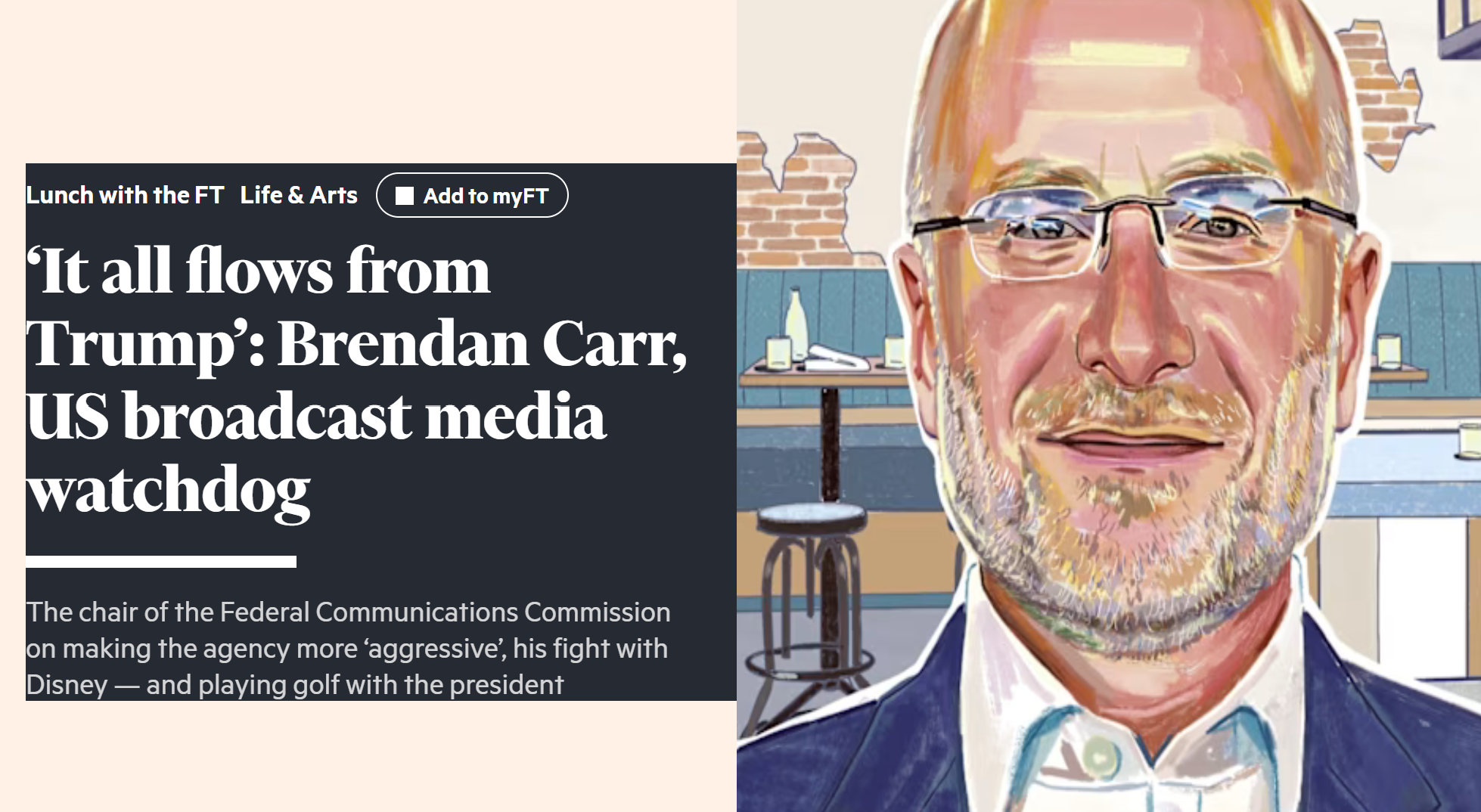
This framing persists through the article, with ambiguous "critics" concerned about America's descent into authoritarianism on one side, and Brendan Carr's claims that he's providing a "much needed shock to the system" on the other.
This style of journalism, called "both sides" reporting or the "view from nowhere," is a trademark of our declining corporate press. It buries the truth in favor of an faux-objectivity in order to avoid offending advertisers, readers (ad viewers), sources, or media ownership (almost always conservative white men).
The result is pseudo-journalistic artifice designed to look like useful reporting. Its function is to sell ads (which it doesn't even do very well), coddle power, normalize corrupt corporatism, and provide a fake sense of understanding to MBAs who don't want to think too deeply about the ethics of their personal pursuit of wealth.
Like most Carr reporting I've read, the Financial Times is able to discuss Carr's censorship, but never mentions that Carr has taken a hatchet to corporate oversight and consumer protection. His real world policy impact on people, workers, and consumers genuinely isn't of interest to them.
Carr's a guy, so we're clear, who destroyed a program that gave free Wi-Fi internet access to poor school kids. He's engaged in a bogus "investigation" into ABC because Jimmy Kimmel made fun of the President's wife. He's illegally destroying media consolidation limits, so right wing broadcasters can dominate and destroy what's left of local broadcast TV. He's derailed long-percolating efforts to stop telecom giants from ripping off inmate families, and gutted U.S. cybersecurity defenses because AT&T and Comcast didn't like being told what to do after Chinese hackers engaged in the biggest data breach in U.S. history.
The well-resourced Financial Times barely scratches the surface. A detailed examination of Carr policy and its real world impact is replaced with mimosas and dabbing.
Like most interviews I've seen of Carr, one gets the sense that he's very excited that anybody is talking about him at all. He strikes you as a formless soggy bag of a man who is thrilled that authoritarianism finally gave him a reason to pretend to be interesting:
“I get this question a lot, sort of like the origin story of someone evil. Like, ‘where did things go so wrong in your life?’” he says, laughing loudly. “It brings to mind . . . you know the scene from Gladiator, ‘Are you not entertained?’”
Better articles on Carr at least inject some thoughts from actual media scholars and consumer interest orgs. Like this Hollywood Reporter article from last year that depicted the mousy Carr as a pitbull, and noted that his efforts to destroy media mirrors that of recently ousted Hungarian Prime Minister Viktor Orban.
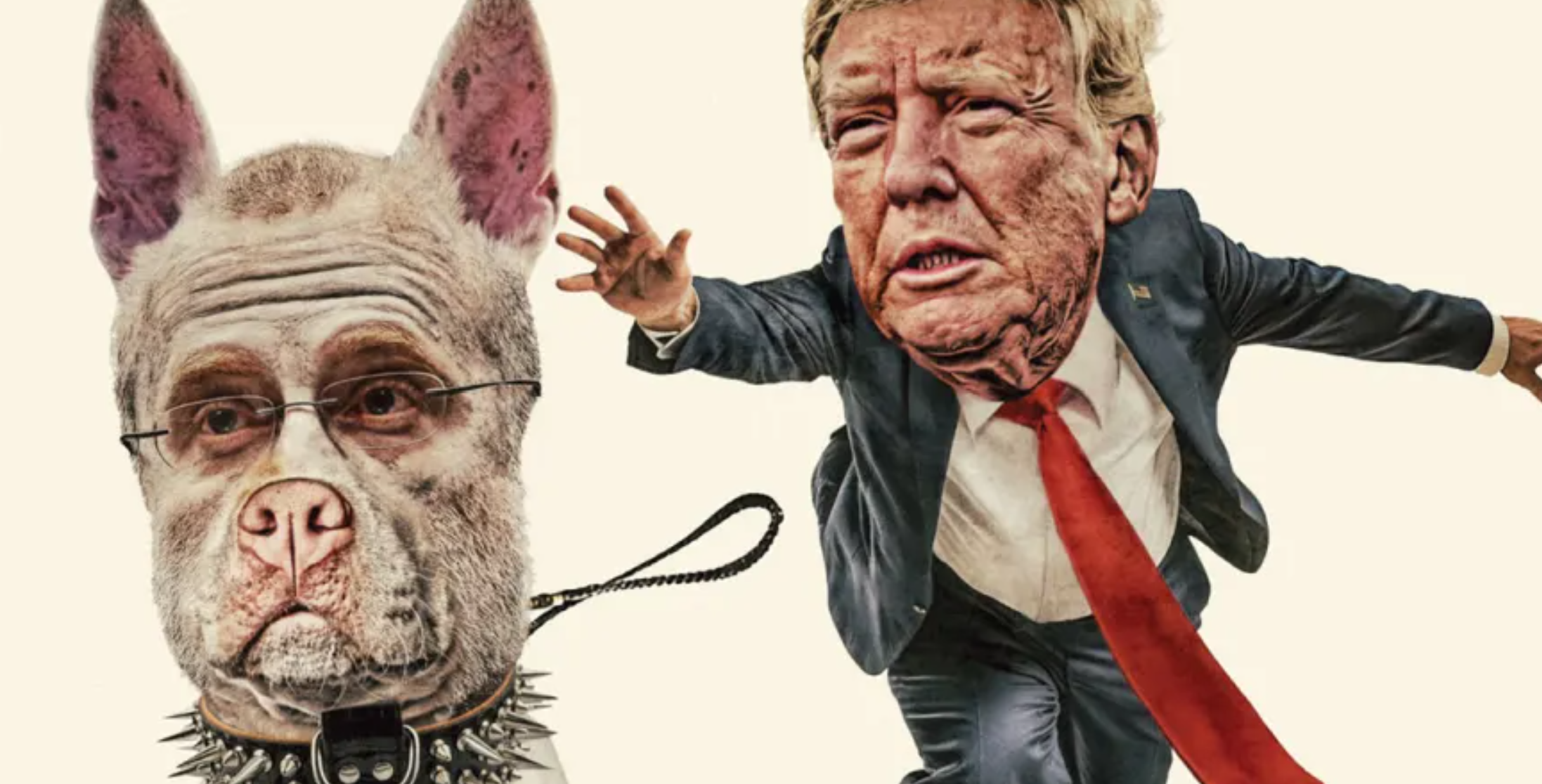
The image of Carr as an unleashed attack dog was something he liked so much he told the Financial Times he made a mug out of it:
"At one point, Carr tells me he saw an AI-generated image depicting him as Trump’s “media pit bull” — unleashed and snarling. He liked it enough to turn it into a coffee mug he keeps in his office.“I sip from it.”
These people are not well.
It used to be a point of pride for a journalist to land an interview with a major public figure. Now, it's more than likely that you were chosen specifically because people in power know you lack the chops to meaningfully push.
Like last week, when it was revealed that new CBS boss Bari Weiss gave Israeli Prime Minister (and noted child mass murderer) Benjamin Netanyahu the choice of his softball interviewers, resulting in a bizarre bit of journalistic kayfabe where his systemic war crimes somehow became an afterthought.
Authoritarians don't just destroy journalism and replace it with propaganda. They hollow out existing institutions and parasitically adopt once-respected brands (CBS, Newsweek, The Washington Post) to create a new journalistic simulacrum. A country with abysmal media literacy standards, where 54% of U.S. adults read below the equivalent of a 6th-grade level, generally can't tell the difference.
They then destroy public media and eliminate media consolidation limits ensuring that major media outlets (from TikTok and Twitter to CNN) are all owned by party-loyal oligarchs. Any outlying outlets that try to engage in actual reporting inevitably face legal harassment, sham investigations, or worse.
Like so much in America the end result is a vast sea of artifice, designed to distract, normalize, and give the vague impression of the thoughtful conveyance of useful information, but with all pointed, truthful edges sanded off to a harmless nub.
Find independent journalism and journalists you respect and admire and give them your money, time, and attention.