Elon Musk's X Rots Your Brain
Data indicates that Elon Musk's X algorithms indisputably drive users into right wing propaganda rabbit holes from which they may not be able to untether themselves.


A recent study had some interesting observations about Elon Musk's X social media platform (formerly known as Twitter).
The researchers took a closer look at algorithmic influence on the social media platform, and found that just two months' worth of use of the increasingly-toxic platform was enough to drive subjects ideologically further to the right:
We found that the algorithm promotes conservative content and demotes posts by traditional media. Exposure to algorithmic content leads users to follow conservative political activist accounts, which they continue to follow even after switching off the algorithm, helping explain the asymmetry in effects.
Some social media platforms, like Bluesky, only show you posts from people you follow in chronological order as they happen in real time. Others, like Threads or X, increasingly fiddle with algorithms to prioritize (or deprioritize) certain content.
What content gets prioritized is dictated by ownership. In the case of X, the algorithm directly reflects Elon Musk's overt support of fascism, sexism, white supremacy, and far right wing ideology. Twitter's algorithm has also been specifically modified by his sycophants to coddle his fragile but bulbous ego.
Musk bought Twitter in 2022 for $44 billion. Despite pretenses about how he planned to reshape the service into a "free speech" platform; he immediately went to work creating a service rife with white supremacy, bots, hate speech, child sexual abuse material (CSAM), and right wing propaganda.
From the study:
Switching from a chronological to an algorithmic feed increased engagement and shifted political opinion towards more conservative positions, particularly regarding policy priorities, perceptions of criminal investigations into Donald Trump and views on the war in Ukraine
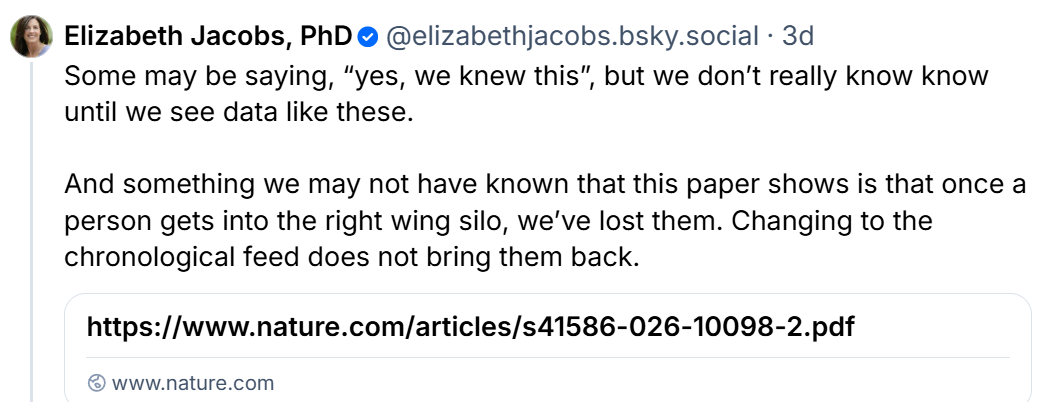
Of particular note: once users had been "on-ramped" into right wing ideology by the X algorithm, switching it back to chronological mode had no observable impact:
Remarkably, none of the political attitudes were affected by the reverse switch from the algorithmic to the chronological feed, that is, by switching the algorithm off.
Which is to say that once these users are high on right wing engagement bait, they're often locked in for the longer haul. Much like the way your relatives' brains were slowly cooked over decades by Fox News. But whereas Fox News averages 3.93 million prime time viewers, Twitter has more than 100 million active users in the U.S. alone.
It probably goes without saying, but far right autocratic corporatism (a government in blind subservience to the extraction class) isn't inherently popular. It requires a broad application of race-baiting propaganda to gestate across the discourse, encouraging broad electoral befuddlement and division.
So right wing billionaires are buying up what's left of already highly-consolidated U.S. corporate media (the Washington Post, CBS, and CNN) and the biggest, most popular social media platforms (TikTok and Twitter), and turning them into a safe(er) space for autocracy. They are, quite unsubtly, trying to construct a bolder, uglier version of the state media apparatus seen in Orban's Hungary or Putin's Russia.
Elon Musk didn't just buy and destroy Twitter because he was super excited to get into the social media business. He did it because the original platform was comprised heavily of journalists that criticized him. He did it because he wanted to dominate the flow of information and amplify right wing propaganda.
Contrary to some public opinion, propaganda works.
There's an inherent and lazy tendency to want to believe in the better angels of human nature; that we're not so eminently persuadable. That leads to a broad consensus that propaganda isn't that effective, and if it is, it certainly doesn't impact me. I am somehow exceptional. I have a good head on my shoulders.
There's a lot of prominent journalists that (for whatever reason) remain on Twitter, confident that swimming in sewage on a daily basis has no discernable impact on their journalistic output or worldview. It's rank delusion.
Shortly after the last Presidential election, we were flooded by a bottomless array of media missives trying to decipher the thinking of the American electorate. Most of these furrowed-brow thinkpieces tried to insist the U.S. public simply had very deep thoughts on complicated economic, immigration, and fiscal policy.
Very few were willing to candidly admit the truth: the average American has little coherent sense of how absolutely anything works (54% of U.S. adults read at or below a fifth grade level), and subsists on a news and information diet of lazy infotainment, agitprop and corporatist sewage.
Few if any of these post-election think pieces meaningfully acknowledged that the U.S. has a very bad right wing propaganda problem. A problem that's been percolating for decades (most notably with the rise of Fox News), and indisputably responsible for the rise of Donald Trump and modern U.S. authoritarianism.
None of this is to suggest human beings don't have agency, that the public doesn't have personal responsibility for their information hygiene, or that America isn't packed to the gills with a lot of ignorant bigots who just really like all the toxic gack that spews from Donald Trump on any given day.
But it's hard to look at the collapse of U.S. journalism, and the right wing corporatist domination of AM radio, broadcast television, cable TV news, and now the internet – and not conclude that it has had a meaningful and detrimental impact on electoral outcomes (I wrote this relevant piece for Vice seven years ago this month where I talked with Stanford researchers about what was coming).
Addressing this problem requires a coordinated, multi-pronged assault the U.S. has shown little serious interest in.
It requires restoring media consolidation limits, embracing publicly-owned media, discovering new creative funding models for journalism, and imposing a new era of media literacy education programs (Finland begins teaching children how to identify propaganda and unreliable narrators starting at 3 years old).
If we're to dig out from underneath kakistocracy, it's going to require an aggressive reshaping of U.S. media. It's going to require Democrats that do far more than pay empty lip service to the value of journalism. It's going to require a comprehensive reshaping of the way we consume information, and very clear limits on the kinds of affluent, amoral assholes we let dominate its distribution.