Jack Dorsey Is A Pointless Dipshit
Jack Dorsey continually demonstrates he is, at best, oblivious to his role in enabling the authoritarian dismantling of democracy and informed consensus. Ethical tech publications should stop mythologizing the unremarkable extraction class.


It can't be overstated how unremarkable most U.S. billionaires are. The vast majority leveraged ivy league connections, familial wealth, and/or blind luck to wind up in the right place at the right time. After stumbling ass first into immense wealth, you'll notice they can rarely replicate any serious innovation.
Elon Musk used wealth acquired from being useless at Paypal to saddle up to actual engineers and take singular credit for their work. Mark Zuckerberg bumbled into ownership of a global ad monopoly, and hasn't demonstrated the slightest indication of wisdom, savvy, charisma, or innovation in the two decades since.
Because they're grotesquely rich, they're slathered with mindless adoration by an access press that tends to mythologize them, creating bizarre hybrid philosopher, sociologist, guru-like caricatures that obscure the fact that most of these CEOs are far less remarkable or competent than the actual engineers they employ.
Case in point: Jack Dorsey, the original founder of Twitter, now X.
Dorsey, who rocks a pseudo-zen microdosing persona free from any of the actual introspection that affect purportedly entails, spent a few years bloviating about building a more resilient and decentralized internet. He then obliterated that goal completely with his assisted sale of Twitter to Musk in 2022.
At the time Jack proclaimed that Musk was the "singular solution" he trusted to guide the website and "extend the light of consciousness" to all of mankind:
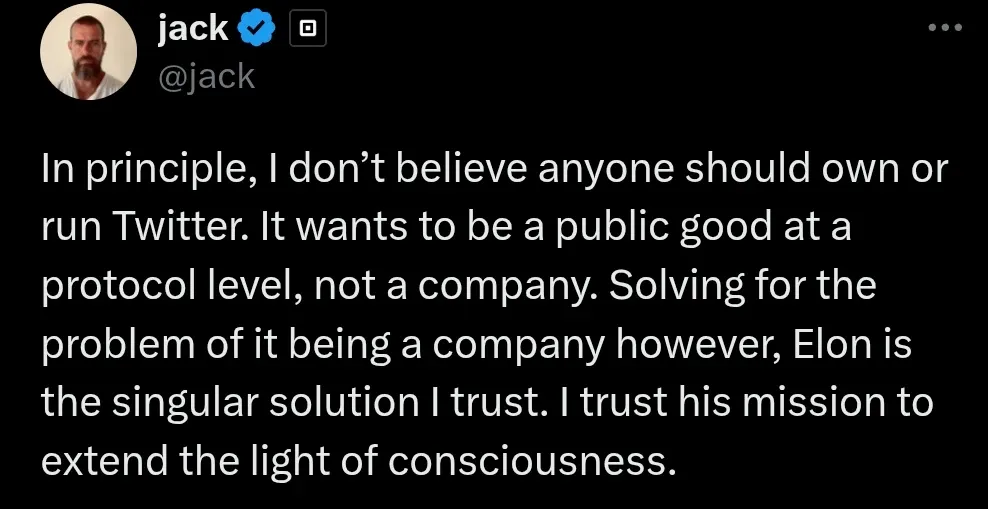
Twitter has since become a propaganda safe space for right wing crypto-hustlebros, fascists, bots, conmen, and barely-potty-trained white supremacists, all swaying in dutiful, orbital service of Musk's gargantuan ego and the authoritarian mission to make everybody else's life significantly more miserable.
In a new interview at Wired, there's very little indication that Dorsey has actually learned anything whatsoever from the experience:
Are you happy with the job that Elon is doing with Twitter, or as he calls it, X?
I'm happy that it's a private company. I'm happy that it's changed its business model. I don't think it's always leading to the most positive outcomes. Some of the algorithmic choices can be improved drastically. And I'm most upset that it fragmented the conversation across ideological lines, versus one protocol being able to host everything. Maybe that desire was just way too idealistic.
(There's been some increased whining about Wired by the extraction class lately because they've generally been doing more critical reporting on the intersections of surveillance capitalism and authoritarianism under Katie Drummond).
The problem at Twitter isn't a few "algorithmic choices" or "fragmented conversations" leading to occasionally "negative outcomes." The problem is an overt white supremacist and fascist purchased a key information platform and converted it into an open right wing propaganda sewer.
A follow up question highlights Dorsey's toddler-esque understanding of modern American politics and the current authoritarian threat:
How are you viewing politics these days?
Super confusing. Everything feels like a mess. The only thing we can do is bring more transparency to how things work, and give access and agency to more and more people. I don't believe one system is going to fix everything, and I don't believe one party is going to fix everything. I've never been on one side or the other.
This is, to be clear, an era when American citizens are being shot in the face by a masked authoritarian gestapo. An era featuring unprecedented corruption at the hands of autocrats. An easy way to identify a dipshit in 2026 is to see if they equate fascism as just "one side" of a legitimate and normal political debate.
Nothing in America will function ever again in the public interest if we don't put the authoritarian movement in the grave.
To quote Howard Zinn, you can't be neutral on a moving train. Fascism isn't a normal political party. It's not something you have a debate with or try to reason with. It's more of a cancer. Saying you've "never been on one side or the other" in the fascist era is like saying you've never taken sides in the need for oxygen.
Dorsey likely has sympathy with the authoritarian movement because, like all American billionaires, he likes mindless deregulation, rubber-stamped merger approvals, and gigantic tax breaks. But if you spend any real time with his thoughts, it becomes pretty clear he also just doesn't understand anything.
There is extremely little Dorsey says or does that could be construed as genuinely original or interesting. He's highly representative of an American culture that's steadily being devoured by its obsession with artifice (innovators that don't innovate, leaders that don't lead, efficiencies that aren't efficient).
Jack Dorsey's most notable achievement in the last five years was recently firing half of his staff over at his mobile payment company Block, then trying to blame AI (staffers say that's not true, and AI is nowhere near ready for the task).
Like most tech billionaires, Dorsey maintains a childlike obsession with technological innovation as a mystical panacea. They're surrounded with extreme wealth and sycophancy so they're incapable of seeing the full impact of their bad judgement when it comes to how technology is implemented.
When journalists point out that the extraction class has done an incompetent (if not outright malicious) job managing the technological intersections of surveillance capitalism and authoritarianism, these types of folks get very fussy:
About two years ago you made some posts critical of WIRED.
Only because I grew up with WIRED. I would go to Barnes & Noble and, like, it would be the first thing I'd search for and read. And I would sit there and read the whole thing. I'm sorry I didn’t buy it, but at the time I couldn't afford it. It was just so focused on this optimistic technology future and hacking culture. It was on the bleeding edge in terms of political ramifications of technology and cypherpunks and the internet. It feels like it's taken such a negative turn, and I don't see the optimism there.
Wired didn't shift as much as reality and corporate power did. In the 90s and early 00s we were bedazzled by the potential of the internet. And while tech can still do amazing things, we've been sobered by the behavior of authoritarian-coddling tech billionaires who routinely demonstrate terrible judgement and overt sociopathy.
If Dorsey did one genuinely helpful thing in the last decade: it was the $13 million in Twitter cash used to help build Bluesky, where users have greater freedom over their feeds and aren't fed algorithmic engagement slop.
When Musk destroyed Twitter, at the time a bastion for journalists, artists, activists, and academics, many of them fled to Bluesky. Here too, you can see how Dorsey either doesn't understand, or broadly misrepresents, the subject he's supposed to be an expert in:
You were the original force behind Bluesky. Are you happy with it now?
No, because it's gone to the other ideology. I left the board. It started taking investment from VCs and building like a normal company. I understand why, but it's not what I signed up for, and it's not why we created the project. We created it to be an open protocol for everyone, not to be something that's against Twitter or against other social media. The largest issue right now is the algorithmic filter bubble.
By "other ideology" he means people who don't support violent, racist autocracy. And the whole point of Bluesky is that there isn't an algorithmic filter bubble. Instead of being shown a feed specifically tailored to prop up fascism and coddle Elon Musk's fragile ego, you're shown your followers in real time.
And while billionaires like to whine about the "Bluesky bubble," what they're usually (ironically) whining about is the uncomfortable feeling they get when they've wandered outside of their traditional sycophancy bubbles, get criticized for saying something stupid, and decidedly didn't enjoy it.
A lot of academics and lefties and journalists do post to Bluesky, but it's because they were driven there by billionaires like Dorsey. Or billionaires like Musk, who is actively waging an open war against informed consensus, education, and U.S. journalism. Jack is whining about, and misrepresenting, a problem he helped create but genuinely isn't bright enough to understand.
The other funny thing of note: while Dorsey may have helped fund Bluesky, he didn't really actually do anything useful to help move his vision of a decentralized internet forward. In response to the Wired article, Bluesky software engineer Paul Frazee offered this since-deleted observation:
"the weirdest part is that this dude just ghosted us during development and then one day was like 'no not this' and bounced."
So basically Dorsey spent a whole bunch of time claiming he wanted to build a decentralized internet, played an integral role in helping authoritarians destroy any potential for it, and now wanders around pretending to give sage advice on business, politics, and the internet with a noggin full of ayahuasca.
Wired has done some amazing reporting in the tech era, but I'm increasingly of the opinion that there's no point in even elevating many of these gentlemen, because they foundationally have nothing honest or interesting to say. There's not even compelling evidence they have a decent grasp on the reality we inhabit.
Editors at tech publications are probably better off looking at the worlds of activism, academia, science, art, and actual innovation, finding creative thinkers and doers who are under-represented and under-platformed, and elevating them instead. Because we're full up on the bottomless bloviations of the unremarkable.