The Lies They're Telling Towns And Tribes About The Benefits Of AI Data Centers
Unregulated AI data centers will not, surprisingly, turn your struggling rural West Virginia town into a modern techno-Utopia.


I really "enjoyed" (read: didn't enjoy at all) this recent piece in The Atlantic (non-paywalled archive link) proclaiming that the backlash to AI data centers is "overblown." It's part of a broader effort by our affluent brunchlord press to dismiss the massive bipartisan opposition to AI data centers as a sort of inauthentic hysteria or un-American foreign influence op.
One lie that companies have been telling local municipalities is that if they greenlight a massive local AI data center, it will immediately bring a flood of savvy innovators to your podunk-ass town.
The Atlantic piece introduces the lie this way:
Michael Mandel, the chief economist for the Progressive Policy Institute, told me that employment gains are likely to grow as new data centers attract businesses that use AI. Companies using the technology for advanced applications—such as for autonomous vehicles and medical research—may benefit from proximity to these centers, because information can travel faster from source to user. The margin is imperceptible to most people using Claude or ChatGPT, but for companies that depend on real-time AI-powered decision making at scale, tiny differences in latency matter. The kinds of businesses that will drive the AI economy are thus likely to set up in communities that invest in data centers.
The Progressive Policy Institute (PPI) is, just so we're clear, not progressive. Or an institute in any meaningful sense. It's one of countless corporate-sponsored "nonprofit" think tanks that obscure their funding sources and try to dress up greed (and a relentless desire for no corporate oversight) as a meaningful intellectual argument people should seriously engage with.
These organizations are useful to corporate power because they parrot the goals and aims of corporate power, but they do so under a pseudo-intellectual, pseudo-academic veneer designed to trick news audiences into believing they're reading the scientific insights of an objective subject matter expert.
I've run into the PPI consistently during my research on broadband. They can often be found breathlessly insisting that modest oversight of shitty telecom monopolies will stifle innovation, or that popular, community-owned and operated broadband networks are some kind of reckless socialism run amok.
Anyway, the Institute's spokesperson, Mr. Mandel, is lying. Plunking down an AI data center in the middle of rural West Virginia will not magically draw a bunch of innovative new startups to the region. And the 5ms or so lower latency from having a server farm in your backyard offers no tangible difference to AI service quality.
That's simply not an actual thing.
Another lazy logical trick data center apologists like to employ is to point to other things we already know are worse than AI data centers to try and downplay very real harms. That comes up particularly often as it pertains to AI data center water use, as The Atlantic does here:
In 2023, data centers directly consumed 66 billion liters of water. That number sounds alarming, until you realize that America’s golf courses used almost 2 trillion liters that same year.
One, 2023 was already three years ago. Two, just because AI data center water use isn't the most pressing issue, doesn't mean it's not an issue. Ask Cheyenne, Wisconsin. Ask Memphis, Tennessee. Ask Mansfield, Georgia.
The rest of the Atlantic piece isn't any better. The author urges readers to ignore the relentless thrum, regional pollution, higher local electrical costs, and potential impact to the local water volume and quality, and embrace the idea that AI data centers are innovation magnets and big job creators.
But most of the jobs are in construction, and even here, there's nothing really stopping companies from shipping out-of-town subcontractors in to do the work.
Once the data center is created, there's very few actual jobs created. And in a country so corrupt that it no longer has functional labor regulators, there's nothing stopping those jobs from being imported as well. Or the workers from being abused or union-busted should the company actually utilize the local labor pool.
What towns ultimately wind up getting is a giant fenced-off campus that drives up local power rates (or worse) and can pollute or strain the local water supply; of particular note since the majority of AI data centers are being constructed in drought-stricken areas already being pummeled by climate change.
Remind me: are golf courses also causing the lion's share of corporate America to abandon their already-pathetic climate change goals? Did we conveniently forget that the orchestra is only getting warmed up for an environmental apocalypse?
These companies aren't coincidentally aiming construction at states and municipalities that are too broken and corrupted to put up meaningful regulatory opposition. They've also started trying to exploit local tribal territories, in the hopes that they can bypass pesky labor and environmental regs:
While energy projects on nontribal lands can face permitting delays of three to 10 years, projects on tribal land often proceed more quickly because tribes wield sovereign authority to handle their own regulations and permitting.
Surely Lucy (the U.S. government) won't yank the football away from Charlie Brown (U.S. tribal communities) at the last second this time (sad_trombone.wav).
A lot of tribes are justifiably skeptical. If the AI hype bubble pops in the way many prominent critics expect, you're going to see a massive glut in data center capacity and a lot of uncompleted AI data center warehouses and campuses in areas that sold the farm in exchange for an economic and employment boon that never arrives, and an innovation revolution that's been broadly misrepresented by a lot of shitty human beings unfazed by whether their product actually works.
I know I harp on it; but U.S. journalism has failed utterly to convey to the public that historic-levels of corruption have ensured that our labor, consumer rights, environmental, and public safety regulators simply no longer function. You're going to see decades of concussive, deadly impacts from this.
It doesn't matter what Utopian outcomes tech companies are promising your town or tribe: there's very little legal or policy structure left to hold them accountable. Federal regulators have been hollowed out almost entirely and your local town isn't going to be able to go toe-to-toe with Meta or xAI in litigation.
Americans can no longer afford to wander around under the delusion that the government has your back or that elaborate accountability systems you took for granted still function. The U.S. government is broken. It's stocked with the equivalent of a bunch of velour-tracksuit wearing strip mall scammers.
In that sort of environment, it's wise to not trust a single word coming out of corporate America and tech companies' gaping maw. They haven't really earned your trust; especially given how many have openly embraced technofascism. The default public position should be extreme skepticism and alarm until we see meaningful reforms and an aggressive political sea change.
If the extraction class professes to be surprised by the violent opposition to AI it's because they're either lying to you, myopically privileged, or reading shitty news sources geared toward blowing smoke up industry's ass (perhaps all three).
They're desperate to have you believe that AI data center opposition is either inauthentic (see millionaire Kevin O’Leary claiming it's a Chinese op) misdirected (see billionaire Marc Andreessen pretending to be surprised when civil rights groups fight for AI pollution standards) or confused (see billionaire Mark Cuban claiming AI data center opponents simply unreasonably hate AI).
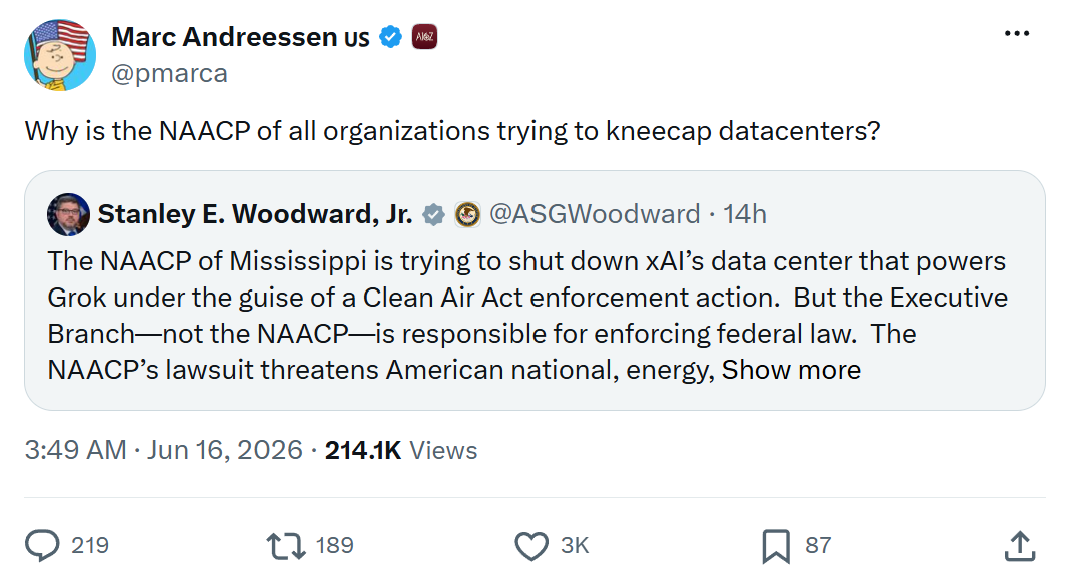
But the fact remains, 7 out of 10 Americans don't want a data center in their communities for very good and clearly documented reasons, and if somebody tried to plunk down a thrumming, formaldehyde-barfing campus anywhere near Cuban, Andreessen, or O'Leary's backyard hammocks, you'd get fucking whiplash and a meaty concussion from all the sudden, whiny consternation.