The U.S. Press Loves To Pretend Widespread Corruption Doesn't Exist
Despite widespread U.S. corruption being anything but subtle, its presence consistently remains absent from corporate media narratives surrounding most U.S. dysfunction.


I just want you to pause and notice something.
The next time you're reading a news story about a particular area of U.S. dysfunction – whether it's gun control, health care, or air travel – notice if the reporter mentions, at literally any point, if corruption and unchecked corporate power sits squarely and undeniably at the heart of the problem.
Here's an example. Earlier this month the New York Times, considered by some to be the pinnacle of U.S. journalism, wrote this story about how the Trump-stocked Supreme Court was preparing to neuter the authority of the Environmental Protection Agency (EPA) to battle climate change (spoiler: they succeeded).
The attacks on the EPA are part of a much broader effort to demolish what's left of U.S. corporate oversight and accountability by an unholy alliance of corporate power and autocrats, the full looming horrors of which the establishment U.S. press has proven incapable of communicating effectively to the public.
The Times story starts off well enough, explaining how our unpopular right wing zealot government was targeting a key scientific determination (the endangerment finding) to ensure federal regulators no longer have the legal authority to police corporations or enforce pollution standards.
But when the article proceeds toward what we're supposed to do next, you hit this gargantuan turd in the road:
A more definitive way to address the issue would be for Congress to weigh in. Democrats could pass legislation that defined greenhouse gases as air pollutants under the Clean Air Act, giving the E.P.A. the explicit authority to regulate them. Conversely, Republicans could enact legislation that said the opposite.
But in the half-century since Congress passed the Clean Air Act, it has never mustered the political will to decide this question. And it seems exceedingly unlikely to happen at a time when climate change has become such a polarizing topic.
Why this Congressional gridlock persists is left as an open question for the reader to puzzle through.
The reason we don't have effective protections for climate change (or functional gun control, or universal health care, or cheap broadband) is because the U.S. Congress is often too corrupt to function. Monied interests have polluted state and federal legislatures to the point they no longer serve the public interest.
This isn't some errant opinion, it's a documentable, provable fact. Yet you'll notice that for the New York Times, the idea that the structural and ethical integrity of the U.S. government has been wholly compromised by the extraction class simply plays absolutely no useful contextual role in the story.
Not only does the Times not acknowledge corporate corruption (in a story ostensibly about how corporate power run amok will avoidably kill untold millions of people), they attribute the real cause of the problem to ambiguous "partisan polarization." It's framed as a problem related to team sports.
We're told that we don't have functional health care, cheap fiber broadband, or functional gun control – not because the companies with a stranglehold over these sectors have lobotomized government norms and ethics – but because of some sort of intangible, inherent, and largely mysterious failure of human collaboration.
This is something you'll see often. It's a rhetorical trick to deflect attention away from the fact that the extraction class and consolidated corporate power (who not coincidentally own the lion's share of modern media) have demolished the structural support pillars holding up a functional democracy.
It's a bad habit of an establishment U.S. journalism industry generally too feckless and compromised by brunchlord class interests to convey the truth to readership (notice the contrast with overseas climate coverage by The Guardian).
Media scholars call this the "view from nowhere" or "both sides" journalism, where the outlet maintains that its function is to provide a certain symmetry to all viewpoints, or risk being accused of partisan bias by an unholy generational alliance between right wing ideology and consolidated corporate power.
As this Times story does, this usually involves giving both sides of a debate equal time and weight (even if one side of any given argument has a head full of cottage cheese and pebbles) under the misguided impression this is "objective journalism."
Needless to say, a journalistic framework of this type is easily exploited by any number of bad actors, from dodgy organizations covertly paid by large companies to pee in the discourse pool, to authoritarian zealots trying to trick a gullible electorate into believing they're populist reformers.
This is occurring pretty broadly across an increasingly consolidated, profit-driven media system that's terrified of upsetting powerful sources (especially if they're rich Republicans), eroding ad revenues, pissing off ownership, upsetting regulators, or just not being invited to the White House Christmas party.
This intentional obtuseness comes despite the Times' own data being extremely clear on the subject of U.S. corruption:
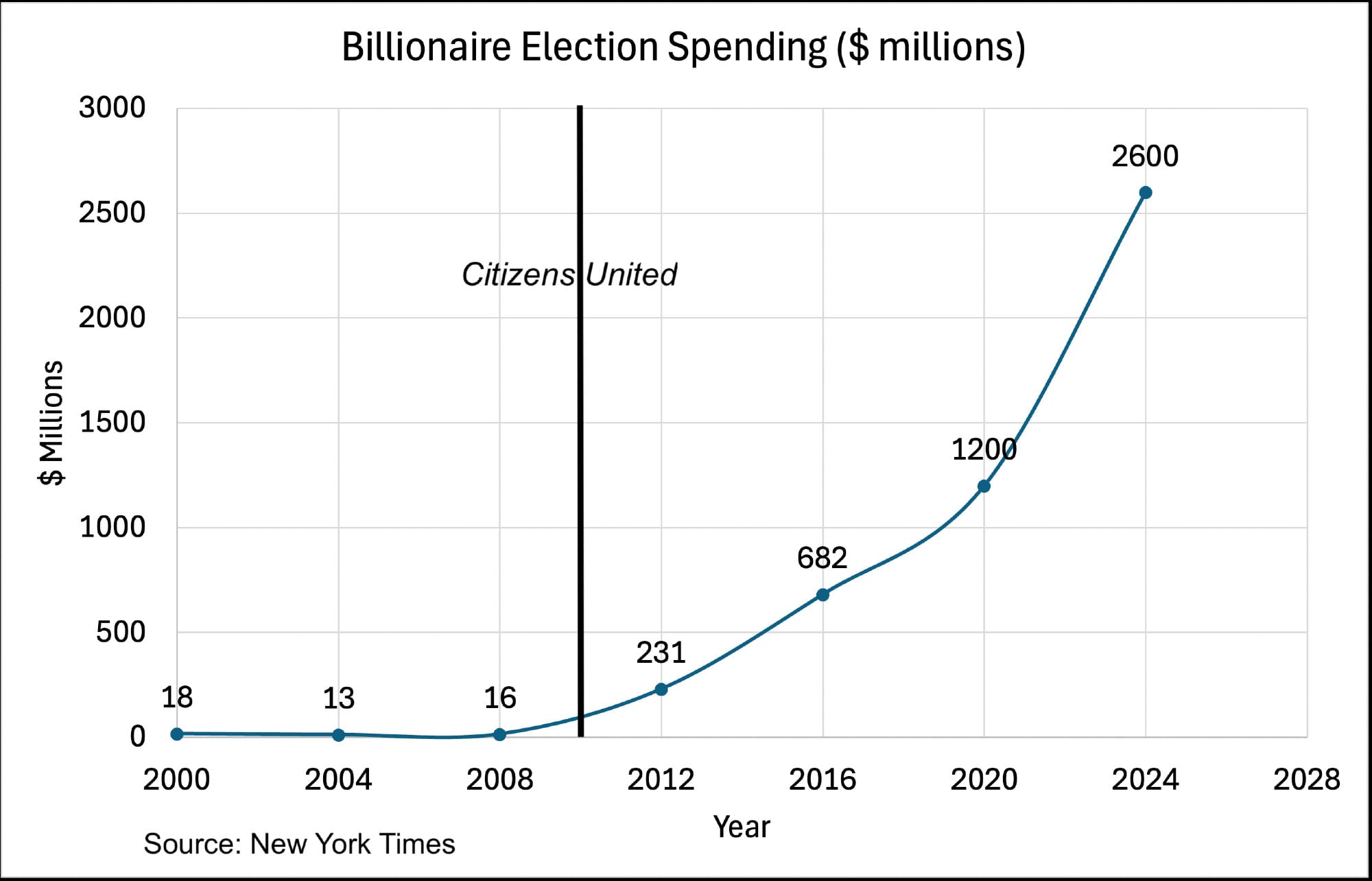
The Times article also, for whatever reason, ends its story by giving "climate science denialists" the final word on whether or not it's a good idea to implement a deadly plan Americans never asked for:
In the absence of congressional action, some climate science denialists said they hoped that the high court would tie the hands of future Democratic administrations for decades to come.
“The goal is not just to rescind the endangerment finding, it’s to overturn Massachusetts v. E.P.A. and make sure this cannot come back, unless Congress decides to get involved,” said Steven J. Milloy, the founder of a website that has disputed the scientific consensus on climate change. “Anything else is not good enough.”
He founded a website. Very exciting.
These are, to be clear, extremists who are ignoring the broad consensus of the vast majority of scientists in order to enact extremely-unpopular policies that will literally kill millions of people. They're given equal (if not greater weight) than scientists that have spent a lifetime objectively studying the issue.
Once you start to see the problem, you'll see it everywhere.
CNN articles on mass gun fatalities can't be bothered to mention that arms dealers have lobbied Congress into gridlock, or remind readers that the U.S is the biggest global arms dealer by a wide margin.
Reuters articles on the soaring costs of America's broken for-profit healthcare system can't be bothered to include a paragraph on the fact that insurance and medical conglomerate campaign contributions make public interest reform all but impossible.
Associated Press articles on America's substandard broadband networks don't think it's useful context to mention that corruption and outright bribery have allowed regional telecom monopolies to dominate the market.
It's as if acknowledging the factual reality surrounding consolidated, increasingly unregulated corporate power is somehow editorially impolite. And these are some of the more reputable outlets American media has to offer; there's entire strata of lower-quality, badly aggregated chum farms vying for ad eyeballs below that.
Major outlets will occasionally still write specific stories about an overt act of corruption if it's attention-grabbing enough to boost advertising revenues, but the fact that corruption is a central and obvious cause of the vast majority of U.S. dysfunction is routinely downplayed or ignored, creating a vacuum into which increasingly-terrible beasts are born.