U.S. Anti-China Tech Protectionism Is Sloppy, Corrupt, And Stupid
U.S. efforts to ban Chinese tech are driven by corruption, crafted by incompetent zealots, and normalized by a shitty corporate press.


From 2019 to 2026 you might recall that U.S. policymakers were utterly obsessed with "Chinese influence" over TikTok.
For those seven years you couldn't spend a day without seeing a lawmaker or pundit hyperventilating over the claim that TikTok's parent company, ByteDance, was controlled by the Chinese government, opening the door to privacy, foreign propaganda, and national security concerns (you were to ignore evidence was weak, and much of the hysteria was cultivated by a direct competitor).
How did Americans "solve" the problem? A bipartisan collection of lawmakers forced ByteDance to sell majority ownership of TikTok to a bunch of Donald Trump's billionaire friends, including Larry Ellison – the anti-democratic right wing billionaire trying to dominate what's left of U.S. media.
It was not a net improvement. The new owners of TikTok are every bit as unscrupulous as the previous owners (potentially more so), and the privacy and propaganda threats to U.S. consumers are every bit as bad. ByteDance at least attempted to behave to remain in the U.S.; TikTok's new owners face no meaningful worry they'll face U.S. government accountability for their sins.
Before TikTok hysteria, there was a protracted, decade-plus-long freak out about Chinese telecom giant Huawei.
From 2008 to 2020, you couldn't spend a day without seeing a lawmaker or pundit hyperventilating about how Huawei's presence in U.S. telecom networks was a dire privacy and national security threat (you were to ignore evidence was weak, and much of the hysteria was cultivated by a direct competitor).
How did we savvy Americans fix that problem? Congress passed a new law requiring that U.S. telecom network operators rip out and replace all of the Huawei gear with significantly-more-expensive domestic and European alternatives. But Congress forgot to finish funding it, the significantly higher costs were passed on directly to struggling U.S. consumers, and to date there's not been any competent federal audit to ensure the work was completed.
Great stuff!
Peppered in between the TikTok and Huawei hysteria, there was also a lengthy freakout about whether we would beat China in the "race to 5G" (next-generation wireless networks).
To win this purported race, the U.S. government slathered telecom giants with whatever policy favors their lobbyists claimed were necessary to thwart the dastardly Chinese (more subsidies, competition-eroding merger approvals, less oversight, the death of net neutrality).
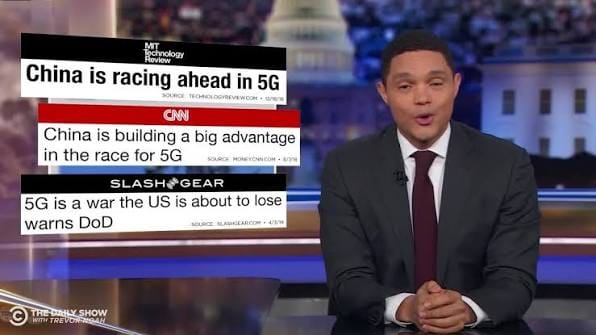
What happened? The U.S. lost the race. Thanks to corruption and consolidation, U.S. wireless is significantly slower and more expensive than a long list of developed countries, including China. Once our telecom giants got what they wanted, everybody just mysteriously stopped talking about it.
I bring this all up because I think it's important to establish a trend: namely that U.S. policymakers, punditry, and the press for decades have endlessly talked a lot of shit about the threat of Chinese influence on tech, but as a country we're too stupid, corrupt and incompetent to actually understand or address it.
More often than not, our fix is just lazy-ass protectionism covertly-driven by U.S. companies that are afraid of meaningful competition. Peppered with crony capitalist tribute systems wherein companies have to pay more money to our mad idiot king if they want to continue doing business in the U.S.
This is all aided by a press that's incapable of pointing out that none of this works because the U.S. is too corrupt to function, and now run by the intellectual equivalent of a wet fart in a velour tracksuit.
The Trump administration is now clumsily trying to ban all Chinese drones, routers, vacuums, lawnmowers, cheap inverters (essential for climate change mitigation), transceivers, and soon AI. You know, because historically-corrupt fascists purportedly just really care a lot about U.S. consumer privacy and national security.
The U.S. drone market has historically been dominated by Chinese drones because they're good, cheap and popular. Without consulting experts, companies, or hobbyists, the Trump administration decided to unilaterally ban Chinese companies like DJI based on baseless claims about privacy and national security (you are to ignore that Trump's sons are trying to get into the drone business).
Most of the press coverage of this has been pathetic, nationalistic drivel that pretends this is all sensible. Though there are thankfully exceptions, like this recent Verge article by Sean Hollister, who points out it's been trivial for Chinese companies to dodge the ban because the DOGE'd Trump FCC is incompetent.
The short version; Chinese drone makers are basically just slapping new brand labels on banned Chinese drones, then opening a fake office in a strip mall to pretend the hardware is domestically produced. The FCC, gutted by a decade of mindless deregulation and regulatory capture, can't keep up:
The FCC could have spotted the OcuSync frequencies, or that this supposedly US-manufactured gadget was tested by a Chinese lab, or that it used a Chinese-made antenna also used by another Chinese drone.
But it’s easier than that. Odyssey Robot declared that its drone was designed, developed, and manufactured at 21 Miller Alley Suite 210 in Pasadena, California. Even a basic Google search can show you that’s not the address of a factory — it’s a coworking space called Industrious that explicitly prohibits members from manufacturing anything onsite.
The end result? U.S. consumers see less product selection, higher prices, and if they do still manage to buy Chinese drones, they're now dealing with companies incentivized to develop fake and even dodgier operations with no guarantee of long-term support for the U.S. consumer. Fabulous stuff.
It speaks to the incoherence of a Trump administration obsessed with taking a hatchet to regulatory oversight, staffing, funding and legal authority, then pretending the remaining husk is load-bearing enough for something this ambitious. They loathe and lobotomize governance, yet still expect it to function.
Even if U.S. anti-China tech protectionism was a good idea (it's not), the current U.S. is too corrupt and incompetent to implement it. And our press is generally too broken to explain to the public than none of this shit makes any coherent sense.
None of this is to suggest the Chinese authoritarian government and Chinese companies don't routinely engage in abhorrent behavior, or that the U.S. government shouldn't engage in meaningful protection of domestic national security, labor, or competition when appropriate and well-informed.
But as the Trump administration has "protected privacy and national security" by trying to ban Chinese hardware, with their other hand they've dismantled much of our cybersecurity preparedness, taken a hatchet to consumer privacy protections, and made it uniformly harder to hold any company accountable for anything.
Ideally, I think it makes sense to allow Chinese companies to compete in the U.S. market, but ensure your labor, environmental, competition, privacy, and antitrust regulators are properly funded, staffed, and have the legal authority to competently police bad behavior and ensure a level playing field.
Large U.S. companies don't want that, because the increased overseas competition and domestic oversight would throttle quarterly returns. So instead we get this bizarre protectionist kayfabe, lazily propped up by a corporate press oblivious/apathetic to its own corporate and nationalism biases.
It's ironic because Libertarian, free market, and rightward-lurching believers in corporatocracy will talk your ear off over cocktails about how much they love free markets, how real innovation is steeled in the fires of intense competition, and how the federal government has no role in private enterprise.
Right up until overseas people with darker skin show up with cheaper and better products (TikTok, AI, EVs, whatever), at which point this particular sect will suddenly devolve into a quivering sack of Jell-O begging government mommy for protection from overseas companies they can't out-innovate.
This stupidity is also, so we're clear, very bipartisan. Democrats played a key role in helping Trump offload TikTok to his billionaire buddies. Banning an app popular with young people during an election where the youth vote was essential to defeat fascism was a turdish policy own-goal for the ages.
And not that long ago in Michigan, several Democratic lawmakers decided it would be a good idea to ban all Chinese-made vehicles from even visiting the state.
Senator Elissa Slotkin (D-Mich.) is obviously trying to protect domestic automakers and their unions from competition, but as with most sloppy U.S. protectionism, the pretense for a lot of this stuff is very often a sudden and breathless concern about U.S. consumer privacy:
“They can certainly come across the border, drive up to Selfridge Air Force base, take some video with the car. The car is a traveling surveillance package. And all of that data that the car is collecting is being sent straight back to Beijing,” Slotkin said.
Here's the thing though. The U.S. is too corrupt to pass even a baseline modern internet privacy law, or meaningfully regulate the data brokers hoovering up your location, browsing, driving, and energy-usage data, then selling access to any nitwit with two nickels to rub together – foreign and domestic.
As a direct byproduct, U.S. companies largely stopped caring about privacy. U.S. vehicles have some of the worst privacy ratings of any industry in America, with your biometric and driving data routinely sold to insurance companies and data brokers. It's trivial for Russian, Iranian, or Chinese intelligence to also buy this data (including data involving U.S. troops deployed overseas).
We utterly defanged our regulators and let corruption hollow out Congress. The U.S. federal government genuinely no longer functions.
Yet we're still somehow subjected to this bizarre, performative pantomime in the press where we pretend the emperor is fully clothed and is capable of following through on elaborate protectionist policy that time and time again doesn't achieve any coherent goal outside of the enrichment of a bunch of preposterous assholes.
The reality remains that if the U.S. cared about consumer privacy, we'd pass a modern privacy law holding all companies (foreign and domestic) accountable. If we cared about national security and foreign influence, we'd dismantle the most corrupt administration in U.S. history. If we cared about social media propaganda, we'd properly fund journalism, boost media literacy, and embrace antitrust reform. If we cared about labor, we'd modernize and bolster unions.
The federal government no longer does these things because it's simply too corrupt to function. And the U.S. press, ostensibly tasked with conveying the truth to the electorate, is largely incapable of bluntly informing the public; in part because the truth might upset advertisers, event sponsors, ownership, and ad outreach.
However counterproductive our Keystone-cops approach to anti-Chinese protectionism has been to date, it's all about to get much, much dumber over the next 6-12 months courtesy of AI.
Large U.S. tech companies are desperately struggling to make money on AI, and are absolutely terrified about a rise of cheap, overseas, on-device, and transparently open source AI alternatives that could easily dismantle their dreams of generational walled garden market domination.
So prepare for a year of breathless and evidence-optional claims that Chinese AI is a dire threat to U.S. consumer privacy and national security, followed by an elaborate bipartisan train of bad policy and shitty new laws crafted by a clumsy coalition of technofascists, extremists, and competition-averse chickenshits.
How do I know? U.S. history simply repeats itself, and the country has a violent, well-funded allergy to learning anything from experience.