Casey Newton And John Gruber Slink Back To Elon Musk’s Right-Wing Propaganda Machine
Tech journalism mainstays are feebly rationalizing their return to a broken, billionaire-run right-wing propaganda website.

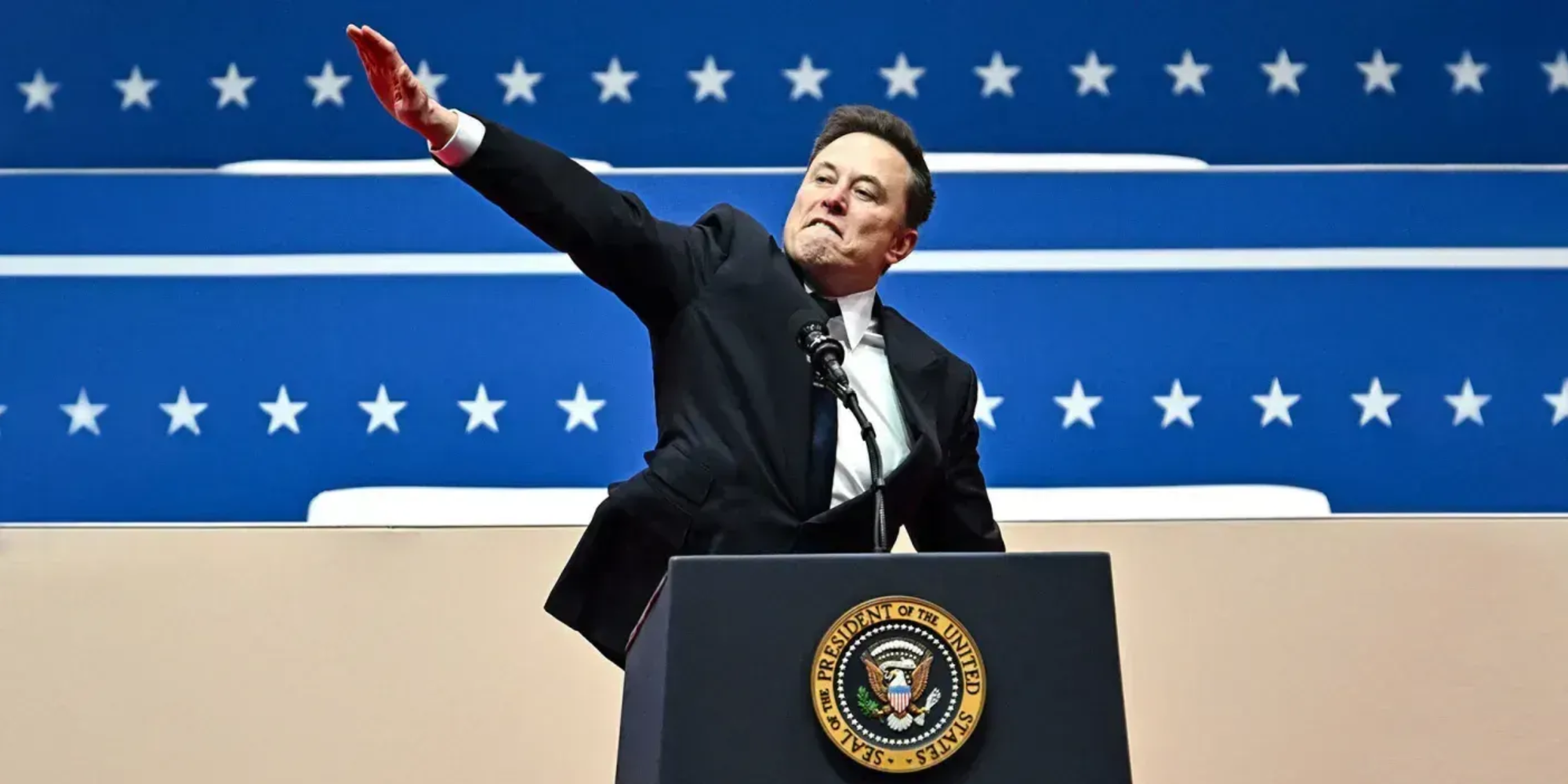
I find it endlessly entertaining watching journalists conduct flimsy but elaborate justifications as to why they still use X (formerly Twitter), a right wing propaganda sewer owned by an overt white supremacist directly responsible for the death of what ultimately may be millions of human beings.
Quick reminder: Elon Musk is an unremarkable and virulent racist who cosplays as a supergenius engineer. He leveraged the money he lucked into at Paypal to opportunistically glom onto actual innovators and take singular credit for their work while consistently cutting corners in ways that put human lives at risk.
There's bottomless evidence he doesn't know how anything works, yet has found unsurprising financial success in a country being devoured alive by artifice.
In 2022, butthurt from growing public and journalistic criticism of his bottomless violations of labor rights, environmental law, civil rights, and public safety protections, Musk bought Twitter and immediately turned the platform into a safe space for assholes, bigots, cryptocurrency scammers, right wing zealots, and trolls.
Musk quickly set to work tweaking the social media website's algorithms specifically to ensure his ego was adequately coddled and to force-feed users a steady diet of right wing agitprop (one study found that just two-months' worth of new Twitter use was enough to drive a person ideologically rightward).
Musk fired 6,000 employees, refusing to give many of them severance. And despite his virulently-racist anti-immigration rhetoric (despite being an illegal immigrant himself), he overloaded and worked his remaining H-1B visa employees (who couldn't quit without risk of deportation) into the ground.
Recognizing the quickly-devolving nature of the diseased website and its pudding-brained owner, many journalists around that time wisely decided to leave Twitter entirely, abandoning a platform that had, until then, become a centralized hub for lightning-fast journalistic conversation and debate.
Musk, meanwhile, proceeded to purchase an autocracy, used his new platform to seed 2024 election disinformation, and subsequently began murdering people en masse via DOGE's dismantling of global relief programs the Musk cult was neither empathic nor ethical enough to understand.
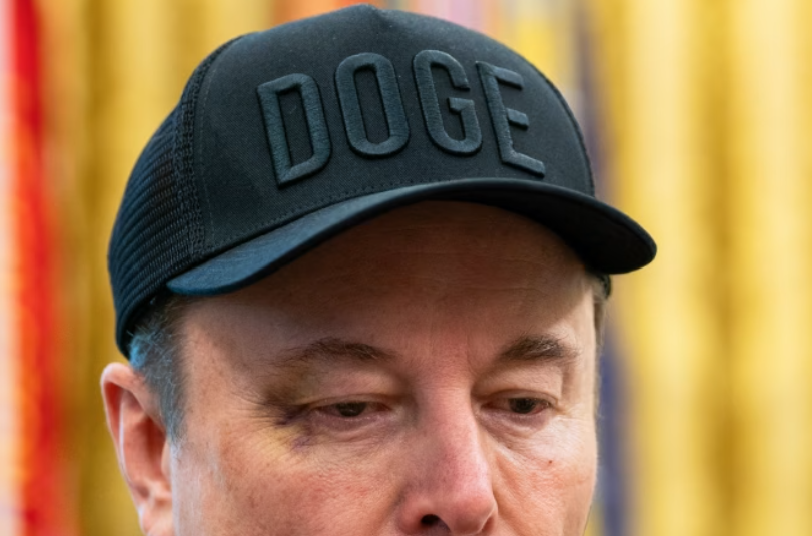
I, personally, like and appreciate journalists that refuse to generate content for a virulent racist's right wing agitprop farm. It shows me the journalist has a very clear ethical center even if it may inconvenience them in terms of total audience reach (though it's worth noting BlueSky often drives more traffic to stories than X).
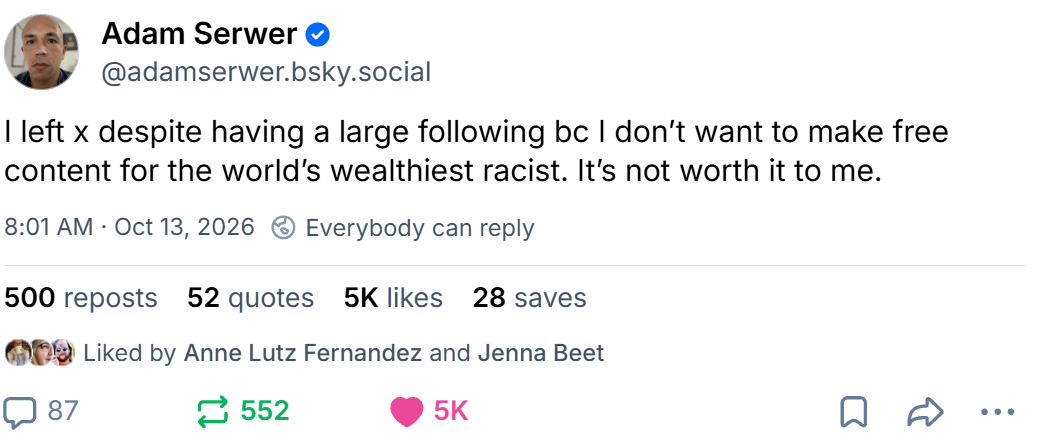
It's been a few years, and despite Elon Musk getting continually and indisputably worse in every conceivable way, there's a growing contingent of journalists who've decided that they're no longer really feeling the whole ethics thing and have announced they're returning to the platform. Cooked brains be damned.
Case in point: prominent tech journalist Casey Newton, the heir apparent to Kara Swisher Silicon Valley access journalism, quit Twitter three years ago. He also was among a flood of prominent journalists that laudably left Substack after revelations that management had courted white supremacists to goose clicks.
But Newton announced last week on his Platformer newsletter that he was returning to X. Why? He claims that efforts to build better social media alternatives have failed, and he simply has to use the platform because that's where all of the biggest AI enthusiasts still post:
in the coming days, I plan to resume posting on X. I am doing so not because I think it’s any better — it isn’t — but because I have exhausted all of the alternatives. I continue to believe that anyone who can avoid posting on X should. But my calculus about the t.radeoffs [sic] involved for my own work has shifted: as the stakes of the AI conversation have risen, boycotting X over my disagreements with management has grown both more costly and less effective.
Should the AI crowd ever move elsewhere, I will happily follow them. But I’ve become convinced that it’s important I engage with them, even if doing so makes me feel like I’m coworking inside a Port-a-Potty.
And by "disagreements with management" he means Elon Musk is a nazi.
Newton claims the only way he can do compelling reporting on AI is to submerge himself in sewage. That's not only false, it masks what I think are the real reasons: having ethics imperiled his financial pursuit of raw engagement at scale; and X is full of a lot of AI enthusiasts more receptive to his particular brand of myopia.
It's worth noting that Newton has routinely been under fire on platforms like Bluesky for potential conflicts of interest (he's engaged to an Anthropic employee), rank boosterism, a tendency to lazily anthropomorphize AI software, and the snotty antagonization of those who have valid criticisms of big tech AI.
BlueSky certainly can be extremely hostile to AI, but that's less a specific failure of the platform and more a natural result of the fact that BlueSky is a niche social media platform filled with refugees from other degraded online platforms, like X and Instagram, ruined by consolidative oligarchic chucklefuckery.
As such BlueSky really isn't a great place to do business if your business is AI industry-friendly gossip and "CEO said a thing!" journalism. That sort of stuff plays much better on X, Threads, cable TV news, Facebook, LinkedIn and pretty much the entirety of establishment corporate traditional and modern media.
Which is to say that if being overly cozy with the industry you cover is your kink, there's no shortage of platforms where you'll be well rewarded.
Newton and his unremarkable New York Times colleague Kevin Roose recently struck a podcast distribution deal estimated to be worth around $5 million annually. They also received a $480,000 grant from a Silicon Valley nonprofit with tethers to the effective altruism and AI sentient doomerism movement.
From a quarter century of intimate personal observation, you don't receive this kind of money if you're doing work that threatens or meaningfully questions wealth and power, though I'm sure Newton and Roose believe otherwise. Both gentlemen have been widely criticized for actively downplaying AI criticism, overstating the technology's capabilities, and blowing smoke up the ass of power.
Newton at least seems semi-embarrassed about his engagement-chasing return to the edgelord meme sewer (see this interview on YouTube he did with Status where Kara Swisher – who was still giving Musk unearned credibility well into 2022 — gives Newton grief for returning to the nazi bar).
The same couldn't be said for Apple Corporation access pundit John Gruber, who took to his Daring Fireball newsletter last week to pen what I think might be the most tone-deaf and embarrassing cack I've read in years. In it, Gruber positively gushes over the idea that X is somehow fun, cool, and fair again:
You can have a discussion about cool new use cases and tools for AI on X and people just discuss the tools and use cases. On Bluesky and Mastodon it’s difficult to have such discussions without arguments from people who (a) believe all use of AI is unethical, and (b) will shove their viewpoints into your replies.
The absolute horror of being reminded that tech companies – including the company Gruber makes his money cozying up to – are routinely and aggressively unethical, and that lack of ethics has seeped into their undercooked software products at diabolical, poorly understood, and incredibly-dangerous new scale.
One hopes he will be ok after such an unnerving brush with abject reality.
What AI boosters often want is to play with their toys without somebody reminding them of uncomfortable truths, like the fact that the lion's share of the U.S. tech industry enthusiastically supported historically-corrupt authoritarianism to the incalculably-fatal detriment of countless of human beings and foundational democracy.
Or that the lion's share of the AI sector is propped up by widespread financial fraud and willful, cultish, apocalyptic delusion. And who wants to have honest conversations about the real-world environmental, labor, or public welfare impact of hyper-surveillance and data center expansion in a country too corrupt to have working regulators. There's simply no money in it (trust me, I know).
With a stunning lack of self-awareness, Gruber goes on to applaud the fact that Elon Musk's bot-infested chud garden feels super inclusive to him personally, an affluent white male clearly disinterested in the real-world politics of AI:
The culture on X today is remarkably friendly and inclusive. It is a cheerful place. That cheerfulness is another differentiator. If you believe the world is falling apart and doomed only to get worse, that our obvious and real problems cannot be surmounted, X is not the platform for you. If you think the world is full of fun and amazing people and things, that humanity’s defining feature is our collective ability to solve any problem, that the only time better to be alive than today is tomorrow, it might be.
Modern X is a platform dominated by wealthy, right wing white men punch-drunk on the Libertarian unregulated tech innovation salvation mythos. But your experience on X as, say, a black female journalist is not what anybody would call "cheerful" and inclusive. The data is pretty clear on this.
Gruber goes on to insist that X/Twitter can't be all that bad because Trump ass kisser and former Apple CEO Tim Cook posted fun Pikachu videos on the platform. He then proceeds to insist that people who have correctly observed and maligned the platform's obvious degradation are somehow mentally ill:
If you have stayed away, or even just mostly away, from X for years and then come back, people just say things like “Hey, glad you’re back!” On the other networks, especially Mastodon, they tell you you’re “feeding Nazis” — by going to the platform where Tim Cook posts Pikachu videos. These people have either lost their minds or refuse to check their prior assumptions. (Most of the ones who chime in about it publicly are the lost-their-minds types.)
Gruber forgets to mention that X under Elon Musk has become a top destination for folks looking to obtain child sexual abuse imagery. Or that data very clearly illustrates how the platform under Musk is an enthusiastic hotbed for extremely racist and sexist right wing rhetoric against vulnerable populations.
How inclusive and cheerful!
Gruber also falsely claims that because his algorithmic X bubble is enjoyable to him personally, this somehow means that Elon Musk stopped fiddling with the algo to coddle his ego and boost far-right wing propaganda:
Without any fanfare — perhaps to avoid his ire — X has de-Musked its algorithm. I stopped visiting at all when the algorithm there was putting Musk’s own tweets into my timeline, every time I checked, despite the fact that I never followed him. But they don’t do that anymore.
This is, as the kids say, weird cope. Also there's no indication that this claim that X's algorithmic bias has been meaningfully addressed is actually true. In fact, there's every indication that Musk continues to abuse X to seed right wing propaganda in the discourse and suppress truthful criticism of it.
Your experience on any social media platform is dictated by the whims and ideological bias of ownership. It's also shaped by who you follow, who you block (and mute), and who you engage with. If you're having a particularly bad time with assholes, it's sometimes because you're either an asshole yourself, you may have said something ignorant, or you're not using site tools effectively.
Or at least that's the case at BlueSky, where you can tailor your feed without algorithmic influence or a billionaire's thumb on the scale of the kind of stuff you're seeing.
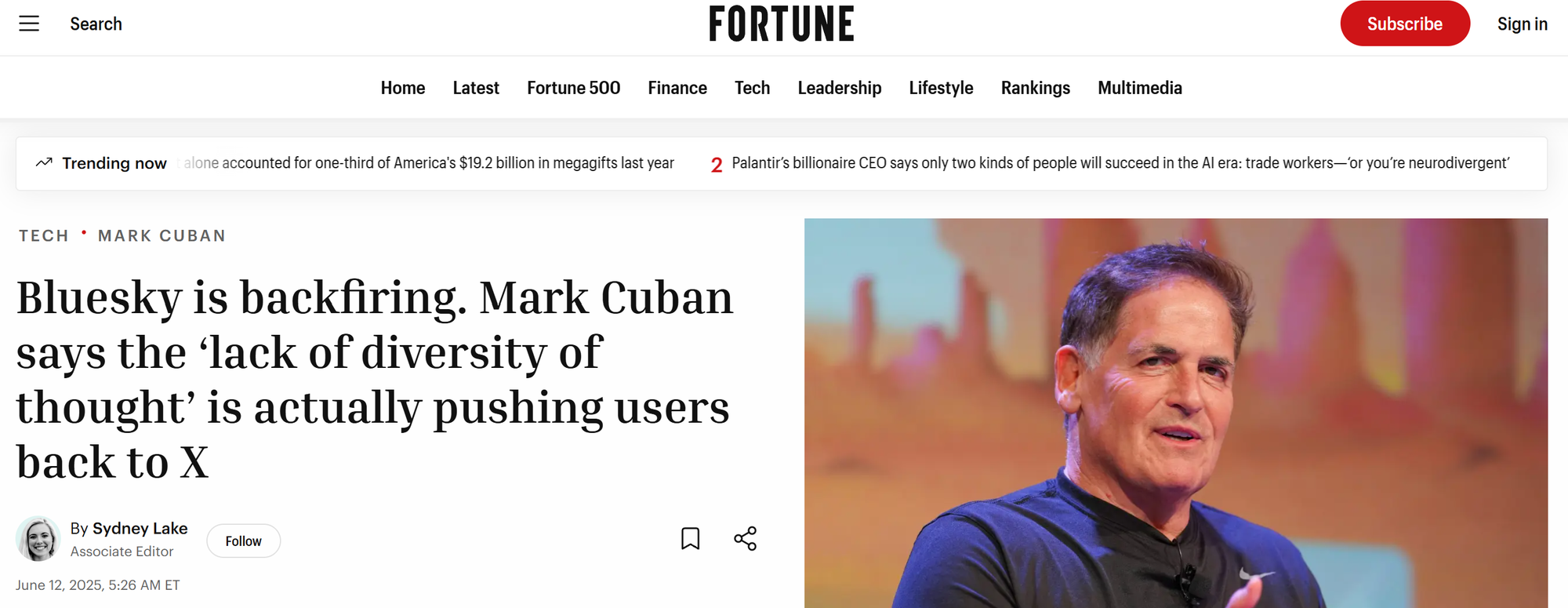
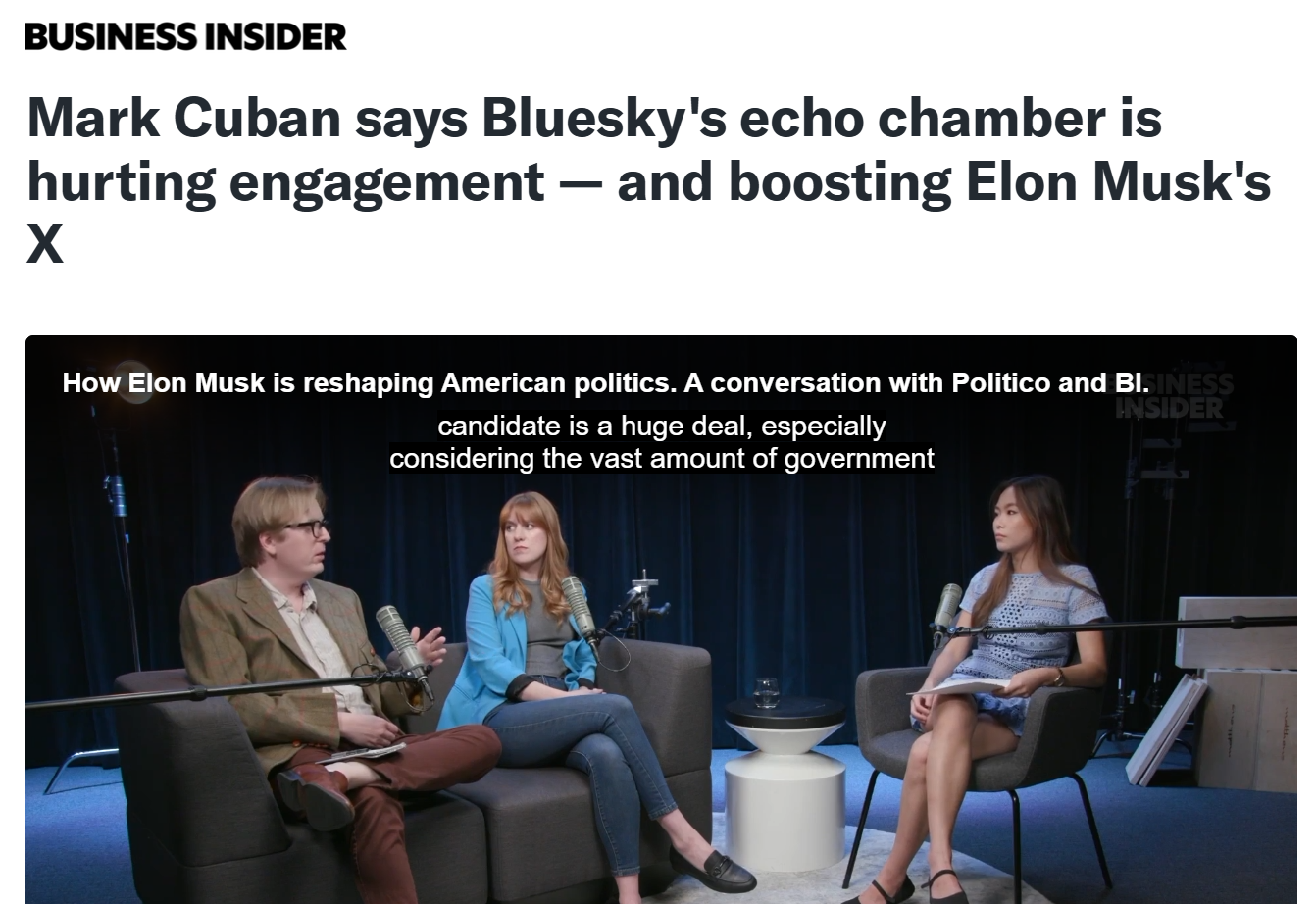
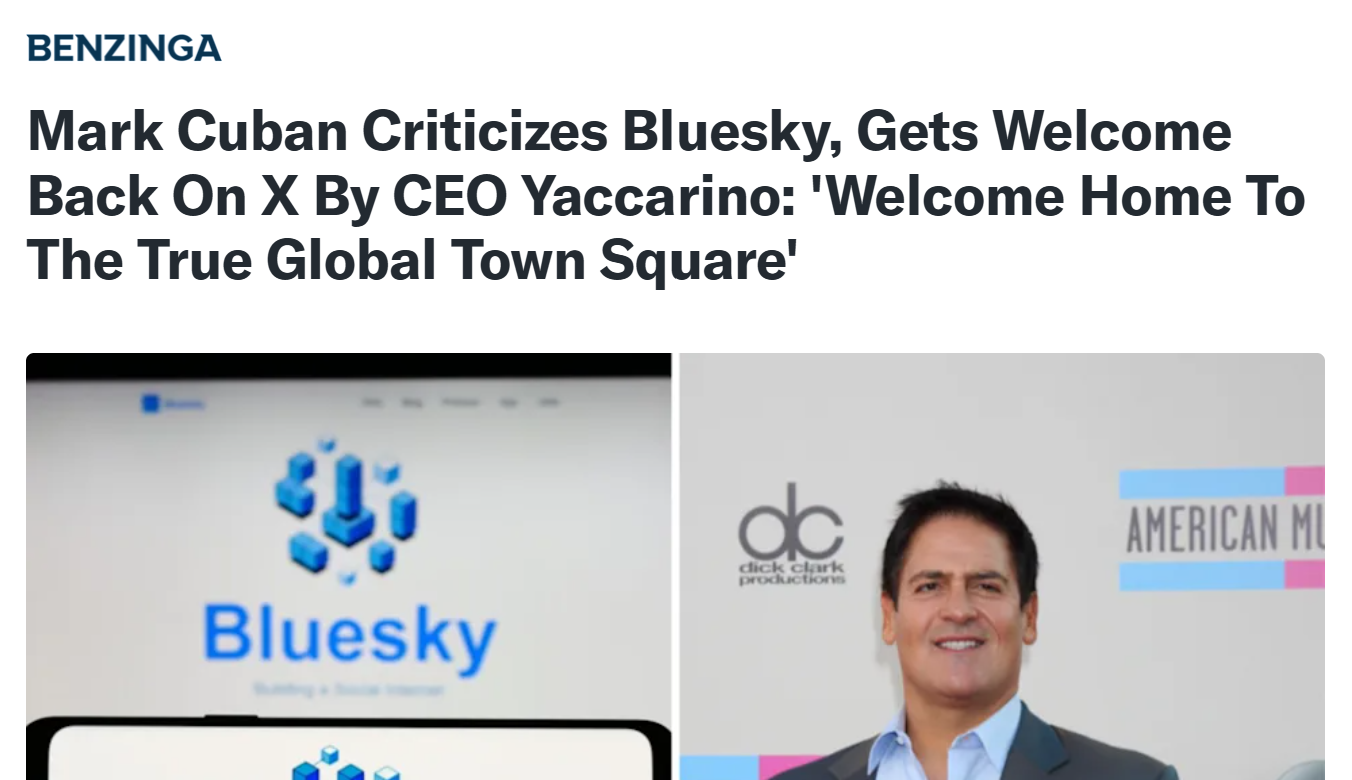
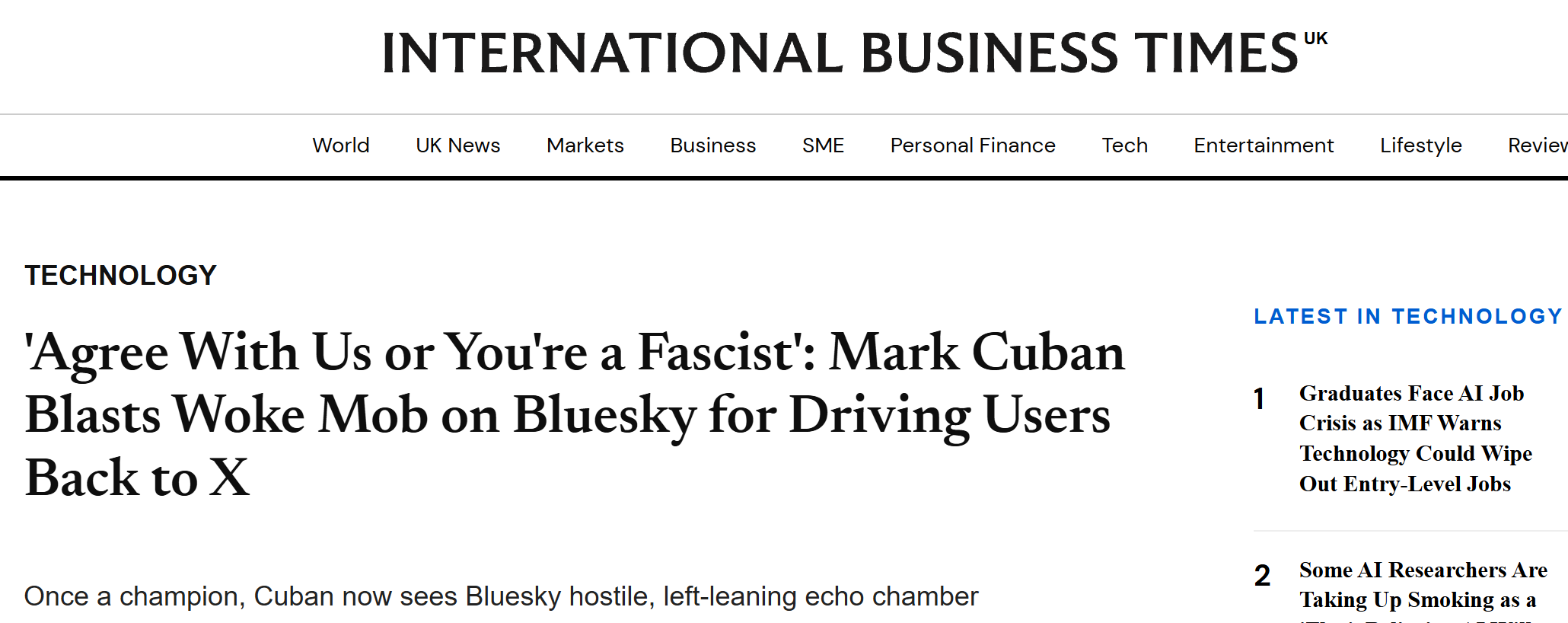
I get endless amusement from the folks – like billionaire Mark Cuban – who step briefly outside of the biggest discourse bubble ever constructed (establishment pro-capitalist white male center-right American media), run into people who are honest with them about their bad takes or ignorant ideas, and then immediately conclude the problem rests with platforms like BlueSky not being inclusive or ideologically diverse enough.
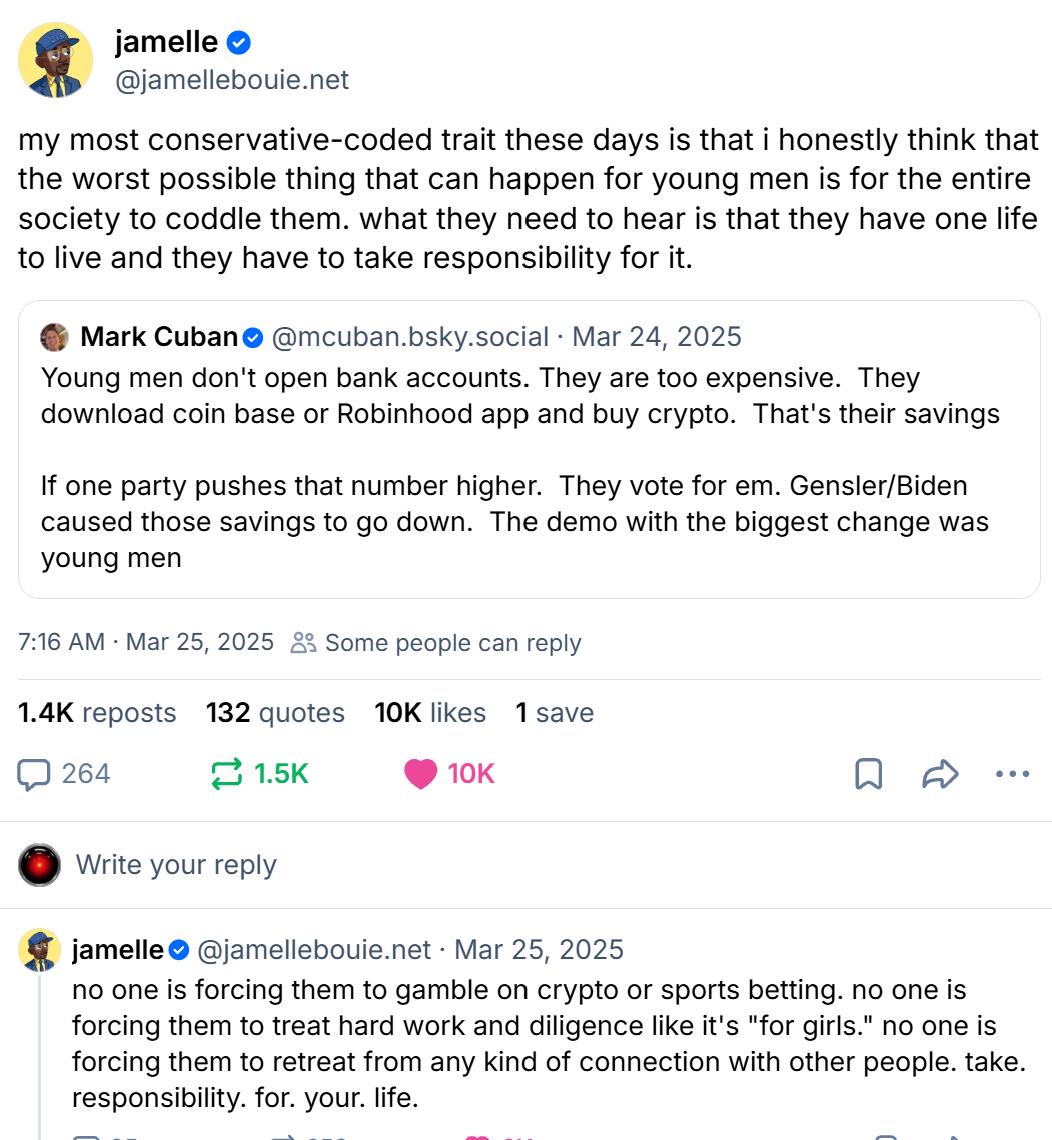
To be clear I don't think BlueSky is or should be a platform for everyone. That sort of diseased pursuit of impossible, all-encompassing scale resulted in no shortage of disasters over the last decade. I think it's good for social media platforms to have niches and to be built around smaller, more manageable communities.
But it's important to observe that every single time somebody on BlueSky would criticize Cuban for saying ignorant or foolish things, he'd single handedly start a news cycle where he concluded the real problem was BlueSky and the only viable path forward is returning to X (which Cuban ultimately did).
the problem cannot possibly be me
This same dynamic plays out with politically-obtuse AI enthusiasts who can't process that the intense hostility to big tech AI is – entirely fairly or not – now inextricably linked to a virulent disdain for the tech industry's enthusiastic coddling of deadly authoritarianism (see how last season's commencement speakers left their establishment bubbles and were immediately shocked by being booed for lazy AI boosterism).
The most bullish AI boosters don't want to talk about politics. They don't want to think about authoritarian corruption. They want to play with their toys. They're quite often predominantly interested in money. When they wander into spaces where the tech industry's abysmal ethics are prominently disputed, they get squeamish and conclude the problem is somehow everybody else.
That's not to say that AI opponents don't engage in their own myopia, but if you do an honest assessment of the last few decades of tech industry behaviors, it's not exactly a mystery why such hostility is bubbling over, or why the opposition to rapid data center expansion is white hot and broadly bipartisan.
You'd think journalists, whose careers are built on understanding bias, would be aware of this particular dynamic and the risks of submerging yourself in X AI group think under the belief you're getting a well-rounded view of reality. Especially given data on how X/Twitter usage quickly cooks your brain.
But access journalism and punditry remains particularly obtuse to audience capture and the brain-rotting impact of taking-up residence in Elon Musk's recreational-ketamine-fueled fever dreams. In part because it's financially disadvantageous for mainstream American writers to behave ethically. But also because they falsely believe that propaganda can't work on them.
As a result, journalists who can't be honest about their unrelenting quest for engagement – and don't really want to address broader public backlash to their boosterism – construct elaborate scaffolding to make themselves feel good about their decision to dunktank themselves in billionaire-sanctioned toxic waste.
I concede it's a challenge for everyday consumers to ethically shop with their wallet in a country full of giant predatory corporations and a broken public interest press. But I do think journalists should be held to a higher standard when it comes to helping normalize and fund fashy-friendly platforms like Substack or X.
Especially if you're aware of how important it is to have healthy online public interest spaces unpolluted by the whims of the richest and soggiest manbabies. Platforms that not only give you transparent control over your feed and data, but don't actively shovel right wing propaganda down your gullet or monetize the abuse of children and the harassment of marginalized human beings.
Folks like Newton and Gruber have financial resources I'll never dream of. They're incredibly well positioned to leverage their contacts and love of technical innovation to help build better platforms for journalists. Instead, we got a lot of weak-kneed white supremacy apologia and a face full of sorry-ass gaslighting.
Criticism of continued journalistic use of Twitter gets dismissed as "virtue signaling," but I really don't think it's a huge ask for folks employed in the factual information business to lead by example and maintain some fleeting semblance of integrity and ethical self awareness in the authoritarian era.